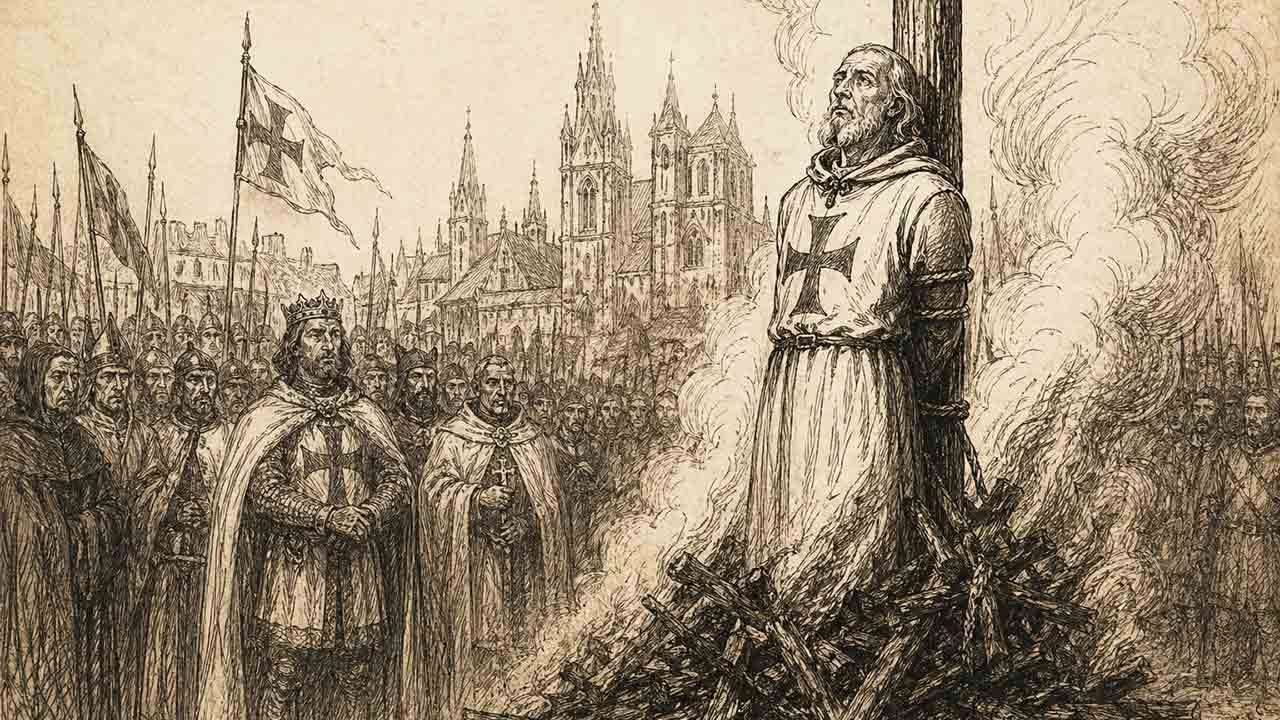

Jacques de Molay was the last Grand Master of the Knights Templar. His execution in Paris in 1314 marked the dramatic end of one of the most powerful and mysterious orders of the Middle Ages.
By Aelius Varro
Few deaths from the Middle Ages gained such a dark aura as that of Jacques de Molay, the last Grand Master of the Order of the Knights Templar. Condemned after one of the most controversial trials of the medieval period, he ended his days before a crowd in Paris, becoming a symbol of martyrdom, mystery and historical revenge.
The story begins long before the flames. The Templars had been created during the Crusades to protect Christian pilgrims in the Holy Land, but over time they became a military, religious and financial power. They had fortresses, properties, political influence and a network of resources that inspired both admiration and fear.
When Jacques de Molay assumed leadership of the order, the Crusader world was already in crisis. The loss of the last Christian territories in the East weakened the prestige of the Templars, while European monarchs began to see that international organization as a power difficult to control.
In France, this tension exploded under the reign of Philip IV, known as Philip the Fair. Deeply indebted and interested in reducing the influence of the Templars, the king launched a brutal offensive against the order. In 1307, Jacques de Molay and dozens of knights were arrested. The accusations included heresy, secret rituals and practices considered forbidden by the Church.
The trial against the Templars remains surrounded by suspicion. Many scholars believe that the confessions obtained at the time were the result of pressure, fear and torture. The fall of the order itself seems to have been less a purely religious case and more an explosive combination of politics, money and power.
In 1312, the Order of the Templars was officially dissolved. Two years later, in 1314, Jacques de Molay was taken to his execution. According to tradition, he reaffirmed his innocence before dying, refusing to accept the accusations that had destroyed his order.
That was when the most famous part of the legend was born.
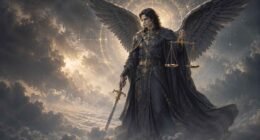
According to later accounts, Jacques de Molay supposedly placed a kind of curse on King Philip IV and Pope Clement V, summoning both of them to appear before divine judgment. The detail that fueled the myth is disturbing: both men died later that same year.
To history, Jacques de Molay was the last leader of a medieval military order defeated by stronger political forces. To popular imagination, however, he became something greater: the Templar who died in the flames, but whose voice would have haunted the powerful men responsible for destroying the order.
Centuries later, his name still appears in books, initiatory societies, documentaries, theories about hidden treasures and narratives about Templar secrets. Between history and myth, Jacques de Molay remains one of the most fascinating figures of the Middle Ages.